Where to use Shade Solar® solar lights
Shade Solar® Category System v1.0
Our branded outdoor solar lights (Shade-1™, Shade-2™, Shade-3™ ) can illuminate from dusk to dawn in shade or sun. They may be used as garden solar lights, patio solar lights, pathway solar lights, security lights and more. They can be located under trees or in shadows. They are designed to operate in 3 kinds of shade zones defined by our Category System. Each shade zone is identified by a category number that indicate its shade characteristic. The greater the category number, the dimmer the ambient light is during the day, and the more challenging the installation site is for daytime battery recharging and overall solar light operation.
The following table is a quick reference guide to help you choose installation sites for our branded solar lights. The left column shows the solar light brand names. The right column shows the corresponding shade category zone(s) for each brand. To use the table, find a given brand name in the left column then read the shade category zone(s) on the same row. Install the branded solar light in the appropriate shade zone as indicated.
Shade Compatibility Table
- Shade-1™ brand Works in shade category 1
- Shade-2™ brand Works in shade categories 1 and 2
- Shade-3™ brand Works in shade categories 1, 2, and 3
"Works in" means that our branded solar lights are designed to illuminate from dusk until dawn when installed in a shade category as indicated by the table. For example, our Shade-3™ brand is compatible with shade categories 1, 2, or 3. Additionally, all Shade Solar® solar lights are compatible installation sites having full sun or direct sunlight.
The table above may be used in reverse as a buyer's guide. In the right column, find the shade category that best describes your installation site. Read the corresponding brand name on the same row in the left column. To ensure compatibility, purchase Shade Solar® solar lights having the designated brand. For example, if your site is category 2, you can purchase our Shade-2™ or Shade-3™ brands because category 2 is listed in the second and third rows of the table above.
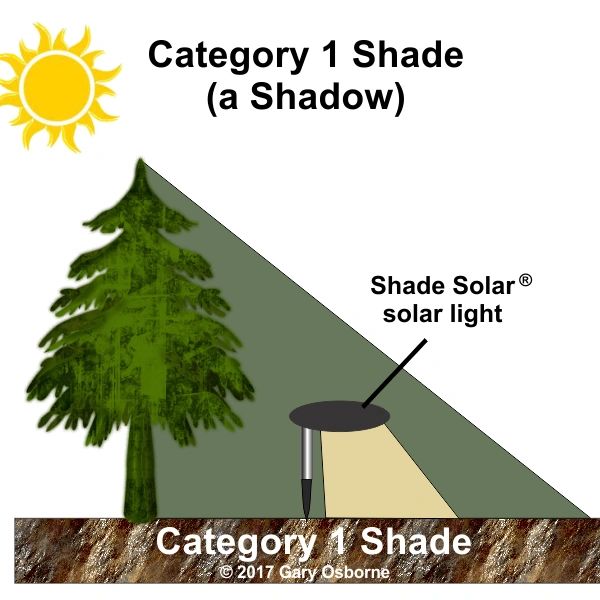
Category 1 Shade
This drawing shows Category 1 shade characteristics which include a shadow and a clear view of the sky above the solar light. The solar panel of the solar light is shadowed from direct sunlight. The shadow may be cast by an object such as a tree or a building.
SHADE-1™ Solar Lights
Compatibility: Designed for sites meeting Shade Category 1 under the Shade Solar® Category System.
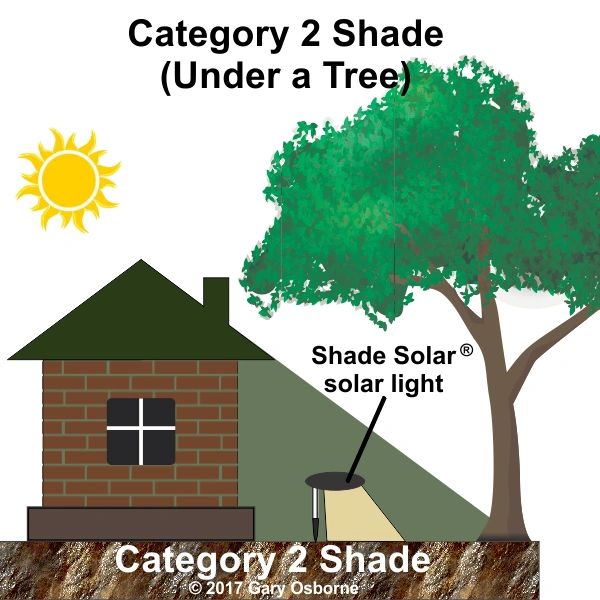
Category 2 Shade
This drawing shows Category 2 shade characteristics which include a shadow and an obstructed view of the sky above the solar light's solar panel. The sky-view is blocked by a tree in this example but other objects or vegetation may provide the same effect. On average, the daytime ambient light is weaker in Category 2 shade which decreases the battery-recharging capability of the solar panel.
SHADE-2™ Solar Lights
Compatibility: Designed for sites meeting Shade Categories 1 or 2 under the Shade Solar® Category System.
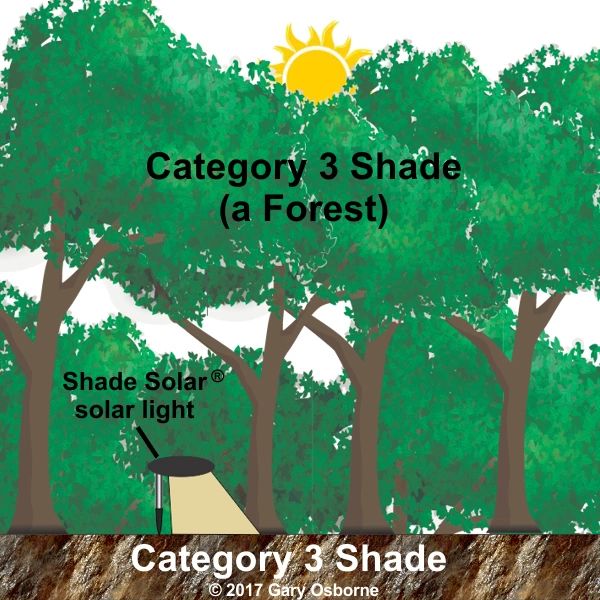
Category 3 Shade
This drawing shows Category 3 shade characteristics which includes include shadows, an obstructed sky-view, and additional obstacles such as trees or bushes that further decrease the daytime ambient light. A forest is one example of an installation site having Category 3 shade characteristics.
SHADE-3™ Solar Light
Compatibility: Designed for sites meeting Shade Categories 1, 2, or 3 under the Shade Solar® Category System.
To ensure a zone-compatible installation, put our branded solar lights in the appropriate zones as indicated by the above table. For example, a Shade Solar® SHADE-1™ solar light located in Category 3 Shade is zone-incompatible and may not produce dusk to dawn illumination. Please note that clouds or overcast may temporarily decrease daytime ambient light of any zone and decrease the nighttime illumination. Dense cloud cover, heavy overcast, an overhead structure, or other factors may increase the category number of a zone and create zone incompatibility and/or prevent dusk to dawn illumination.
Published by Gary T Osborne
EFFECTIVE DATE: August 20, 2026
APPLIES TO: solar light installation sites and compatibility
REFERENCE METHOD: The Category System v1.0 draws on concepts and methods described in U.S. Patent Application Publication No. 2018/0337552 A1, titled APPARATUS FOR A SOLAR PATHWAY LIGHT, published November 22, 2018. For additional technical background and examples, see that publication.